A bookstore experience that reimagines how readers discover their next great book
Although bookstores remain community cornerstones, they’ve seen little operational innovation despite broader shifts in physical retail. We set out to reimagine the in-store experience, turning bookstores into destinations that readers want to visit again and again.
My role
Discovery research
Storyboard concepting
Prototyping
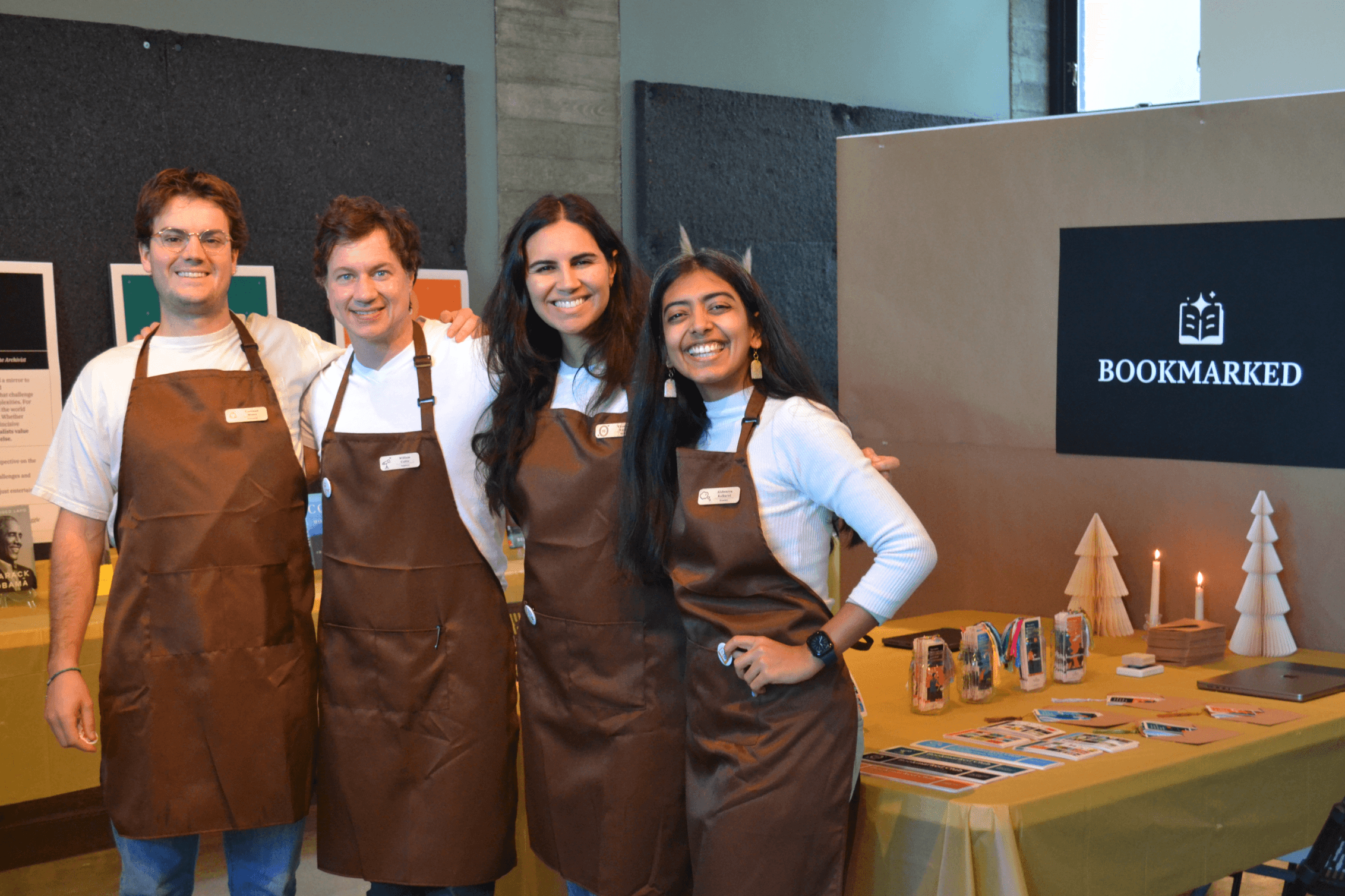
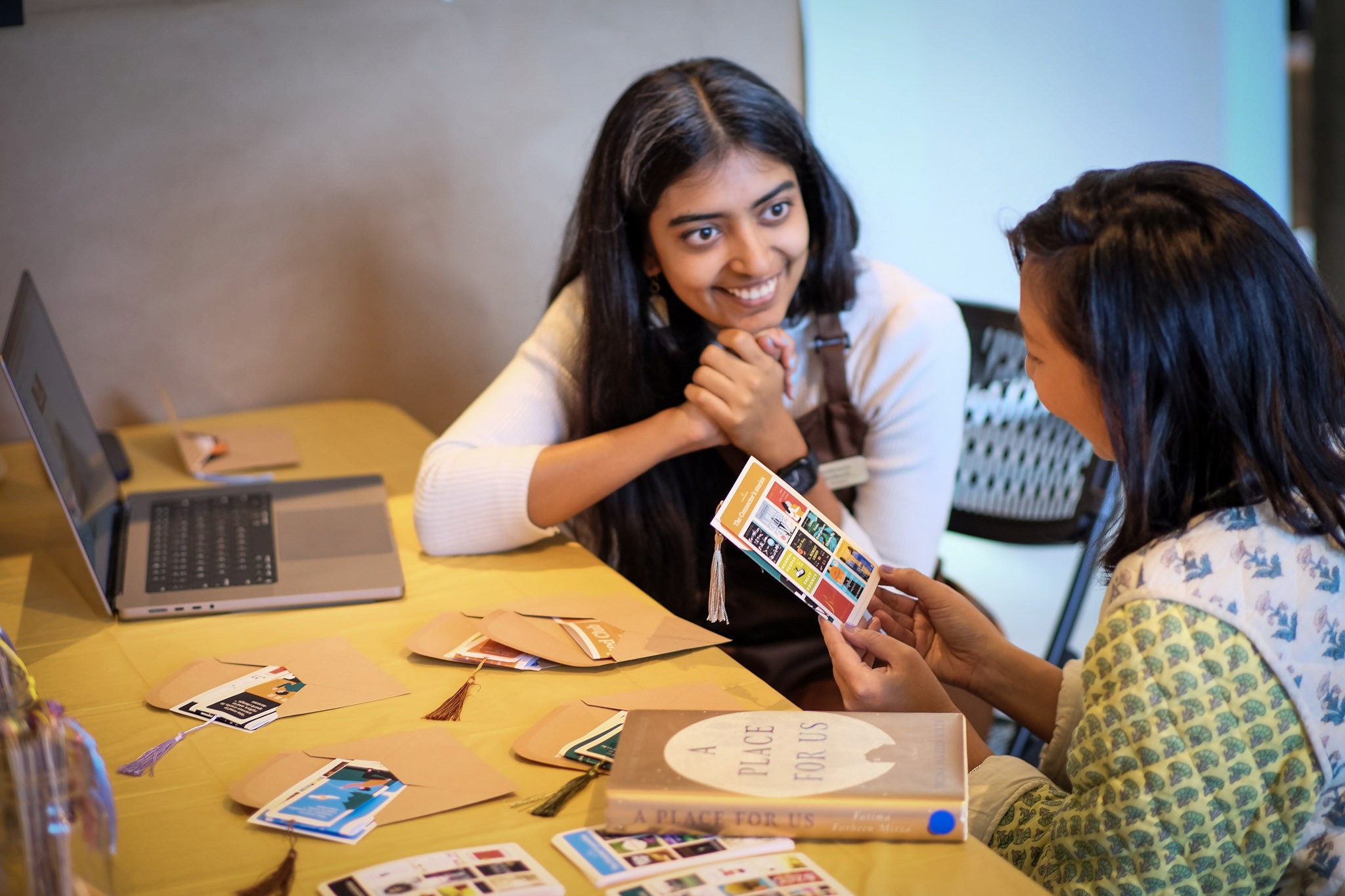
Pop-up launch with the public
Category
Experience Design
Pop-up Retail
Team
Cortland Moore
Ash Kulkarni
Will Collie
Yasmeen Kamel
The role of retail stores has transformed from purely transactional spaces to immersive environments where customers can connect with brands on a deeper level. "Stores are reevaluating the point of the store and how much of it needs to be about inventory per square foot versus experience per square foot."
- Melissa Gonzalez, Principal at MG2
01.
Frame
Trends driving the retail revolution
Phygital & Omnichannel Integration
84 % of Gen Z say they value brands that seamlessly blend digital and physical touchpoints.
Experiential “Retailtainment”
Moving beyond product displays, stores are becoming playgrounds of entertainment live demos, AR games, pop-up art installations, and branded events.
Smaller Retail Formats
These design changes can allow brands to create highly curated spaces focusing on engaging customers
We took a two pronged approach to discovery research.
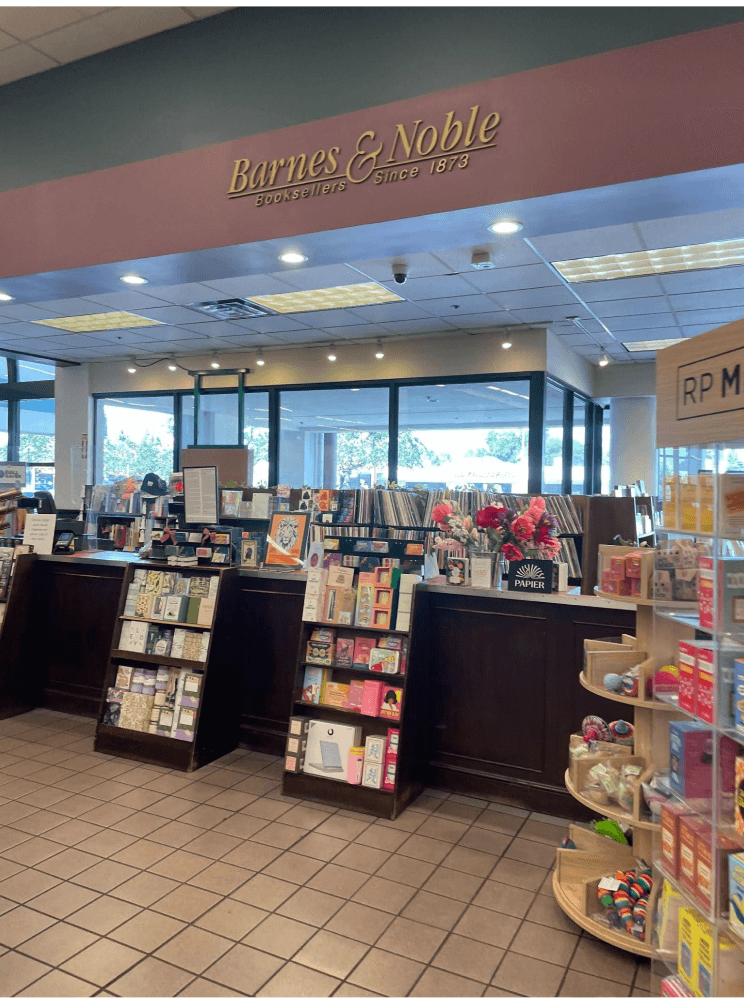
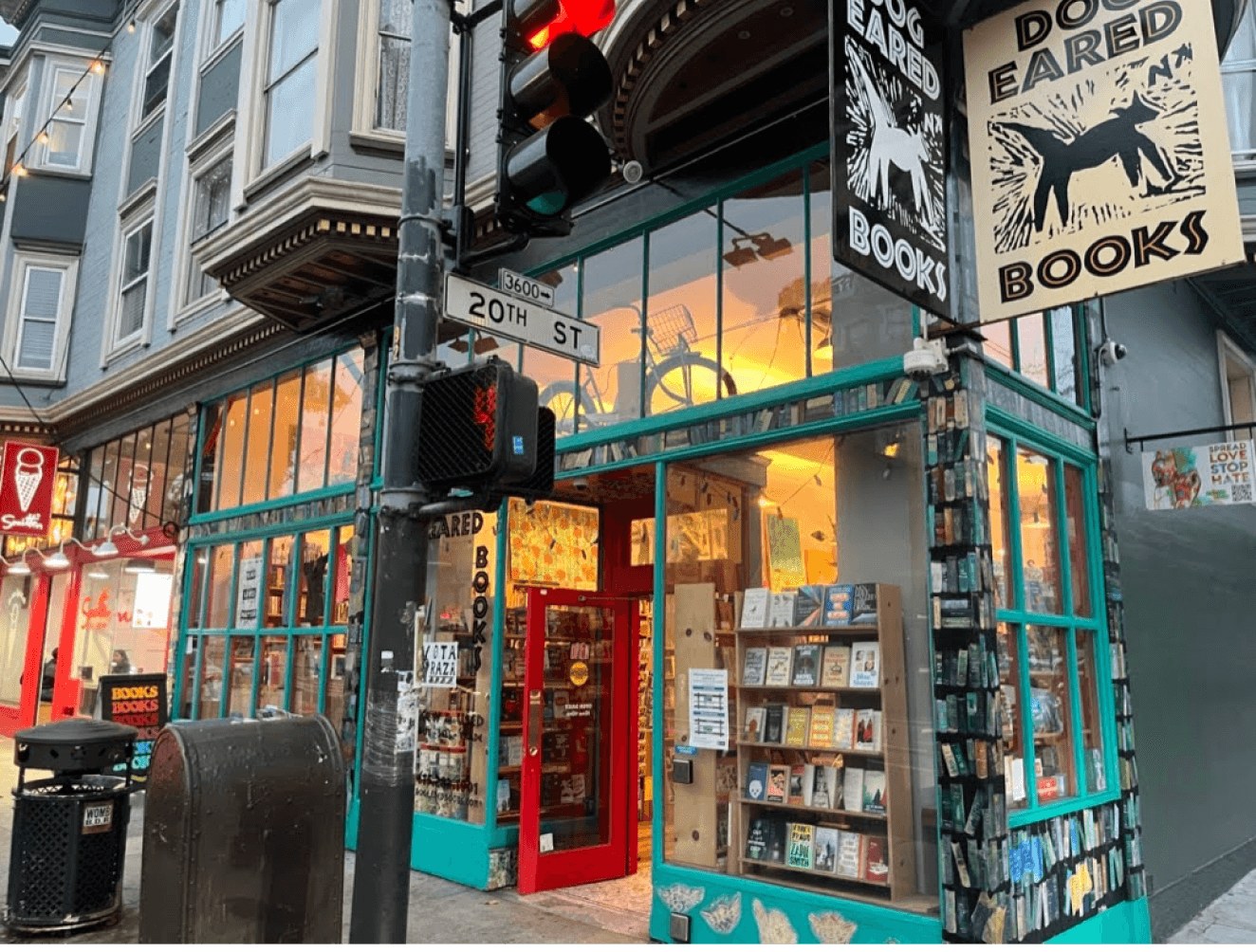
We chose four bookstores that ranged from big box to independent to explore four different physical and digital experiences applying the 5E framework.
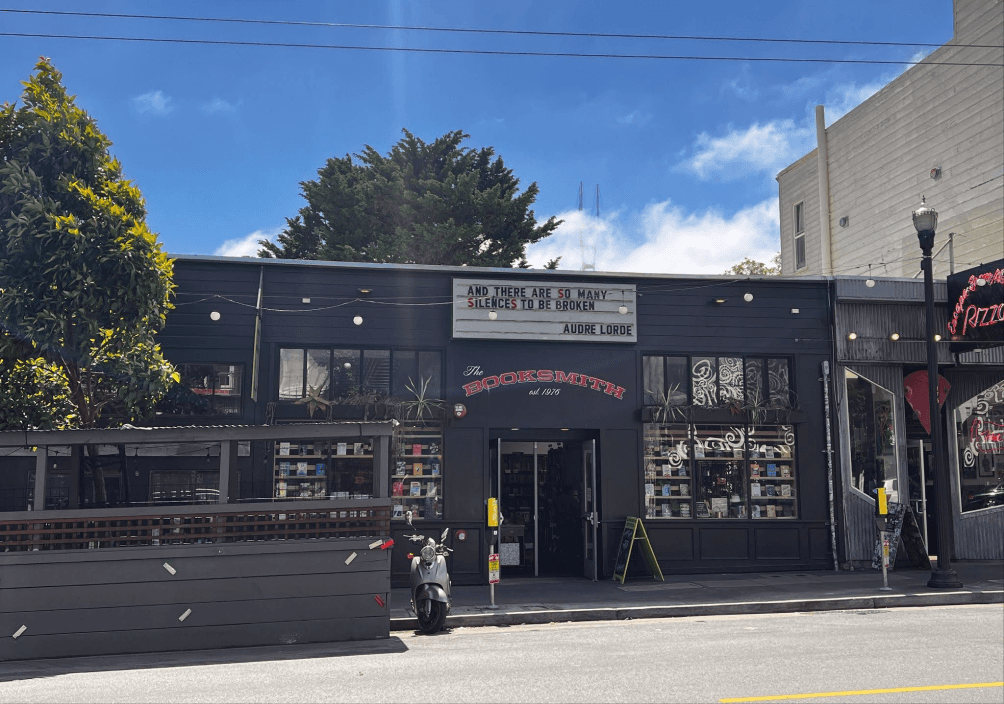
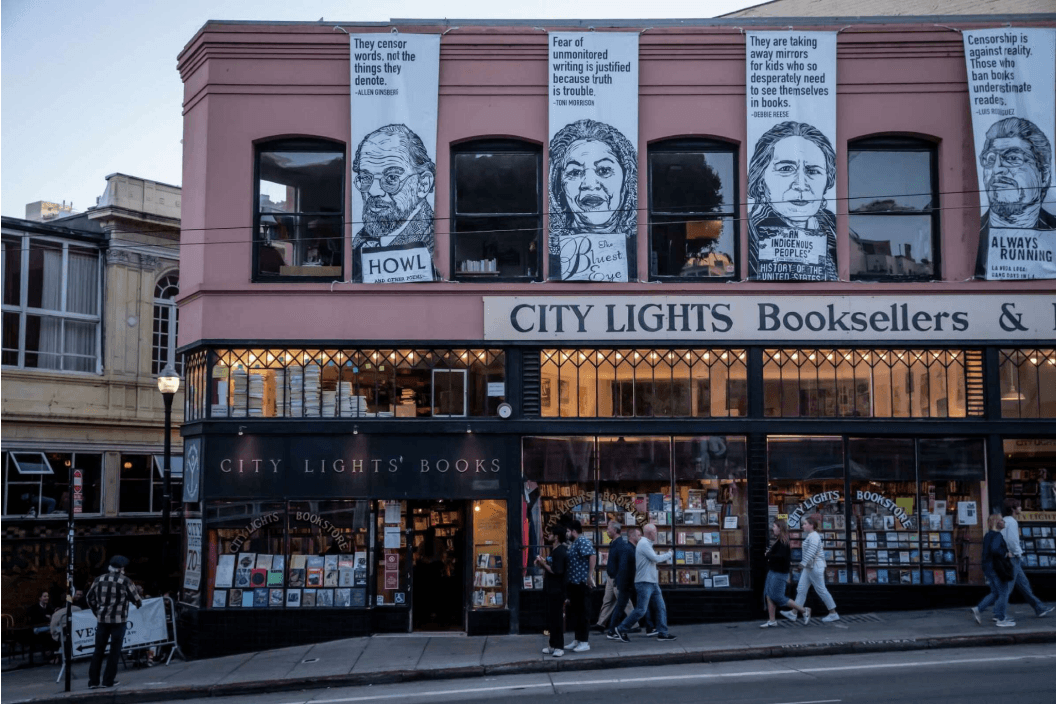
We ran five 60 minute interviews with young professionals who are self described avid readers and go to bookstores at least once a quarter to understand their bookstore experiences, expectations, motivations, and buying practices.
Research Insights
Jobs to be done
01.
Most described their dream bookstore as an “escape from reality”:
[Emotional]: HMW create an experience for readers that feels like being inside a book or discovering a new travel destination?
02.
Store Layout: Most prefer open but organized layouts and cozy vibes:
[Social]: HMW create a third place where readers connect over books separate from the book discovery experience?
03.
Feel inspired to explore: Most go to bookstores without a mission but explore areas of interes
[Functional]: HMW help readers unsure of what to read next find the right book match?
04.
Use recommendations to guide the experience: including digital tools
[Functional]: HMW better integrate digital and physical experiences in store for readers who track what they want to read?
02.
Explore
Exploratory challenge statement
How might we transform the book search for book lovers open to discovery into a more personalized journey?
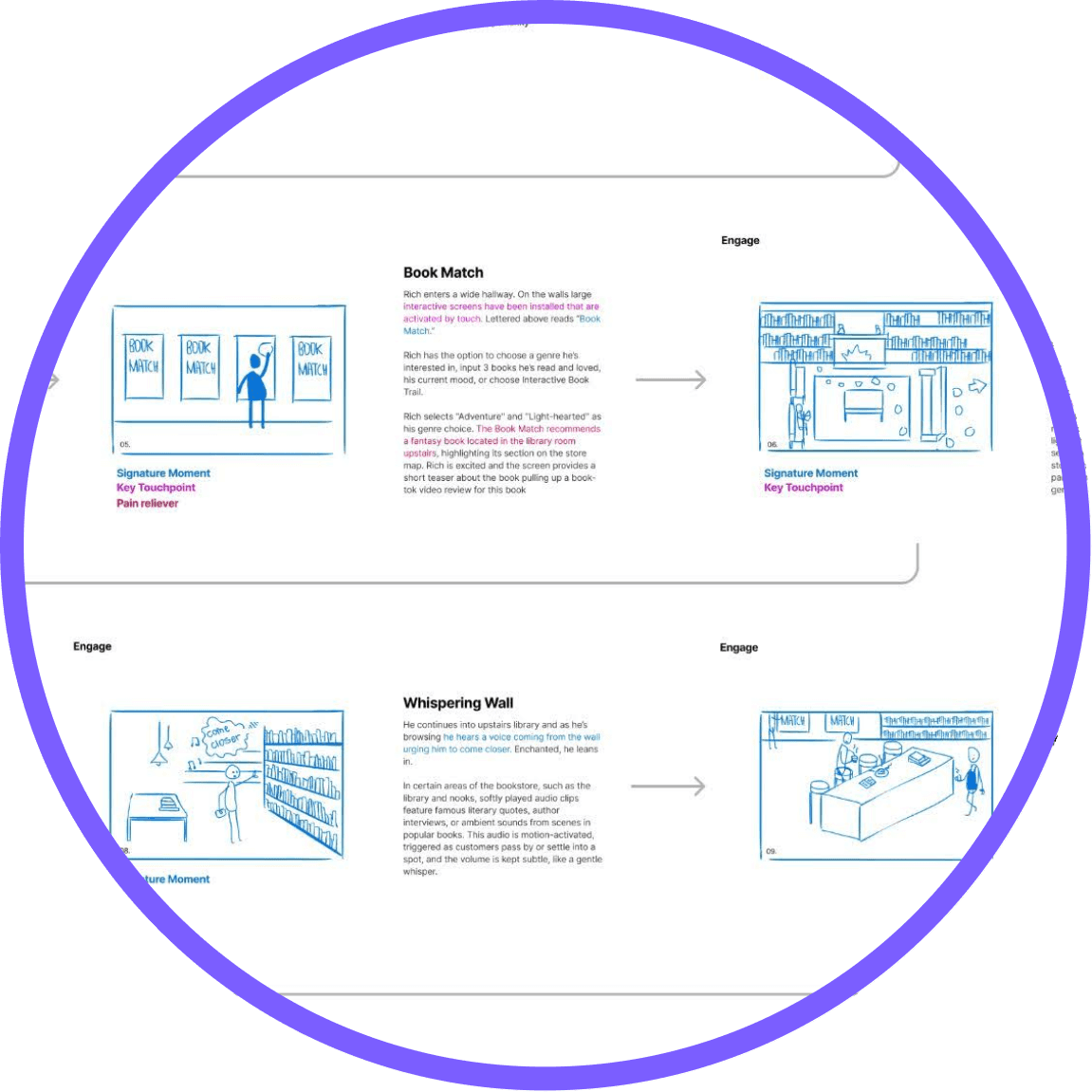
Book House:
High concept: An Airbnb rental that has been transformed into a cozy bookstore experience.
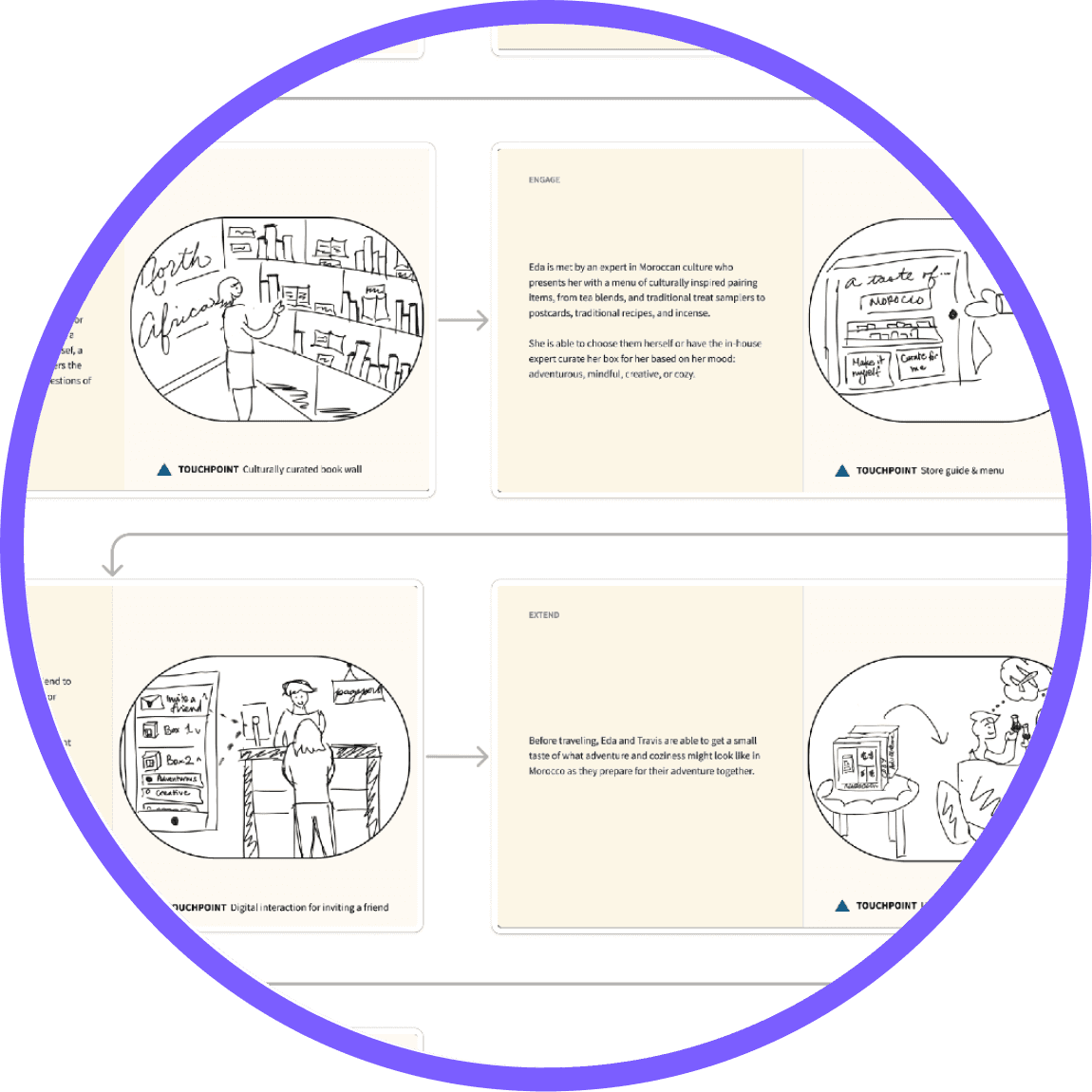
Pageport:
High concept: Book pairing boxes inspired by travel / culture and connection.
Storyboard Interview Insights
05.
Find the next perfect read: People appreciated new ways to discover books through special curation (ex: book match, region of the world, mood).
06.
Third Place: People want bookstores they can spend time in as if it’s a third place.
07.
Fantasy Elements: Book lovers loved the magical elements (ex: whispering wall, sound effect, ability to transport mentally and emotionally).
08.
Mementos: There is excitement for collectibles/box: an extension of the book, an opportunity to decorate a homespace, and something to remember the experience by
Generating a framework
Based on design discovery insights
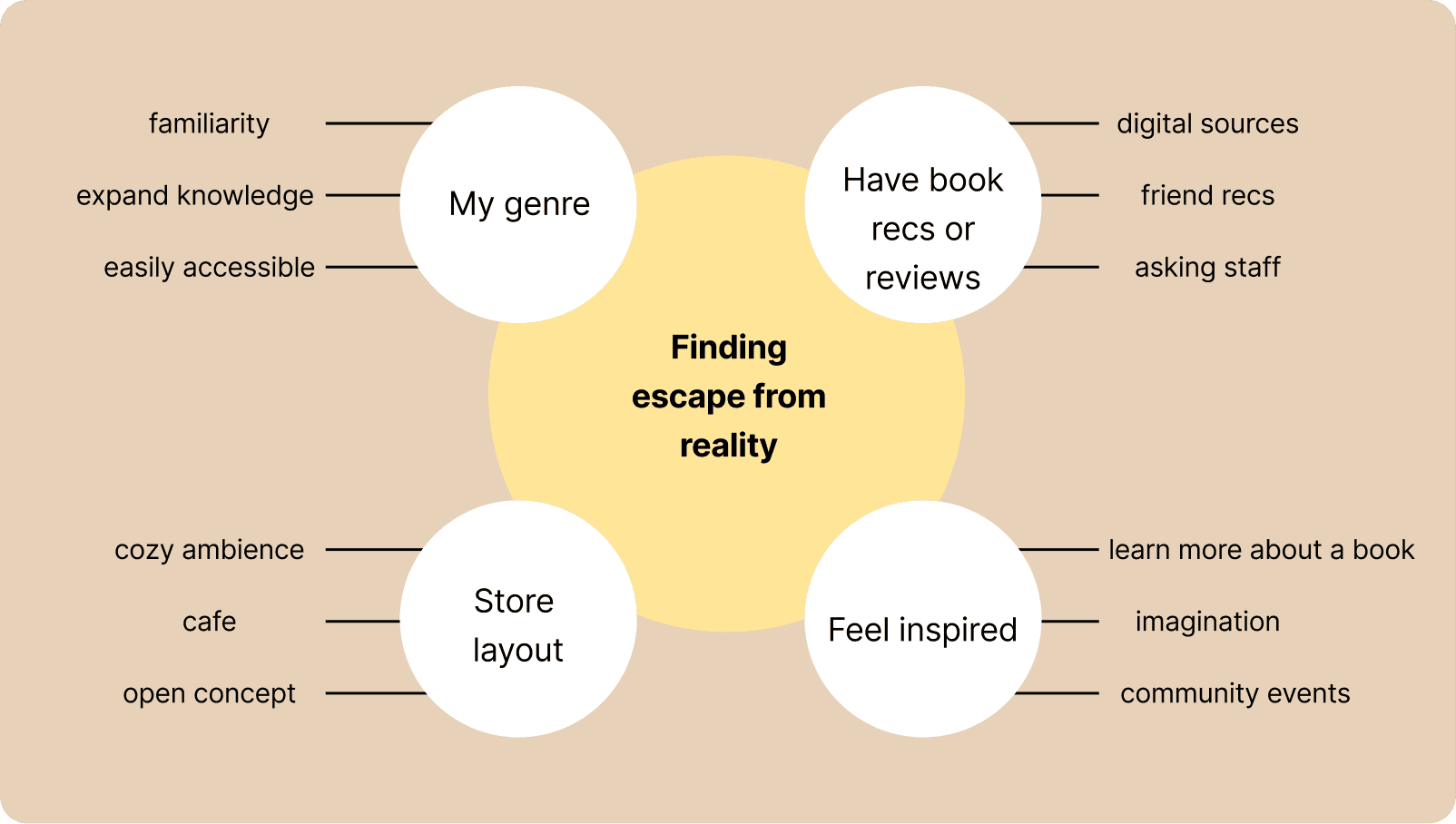
We used our initial insights to create a framework that helped us consider how our experiencescape could evolve.
We found that at the center of the bookstore experience was a desire to escape reality. Secondary factors fed into this larger theme.
Updated via concept storyboard insights
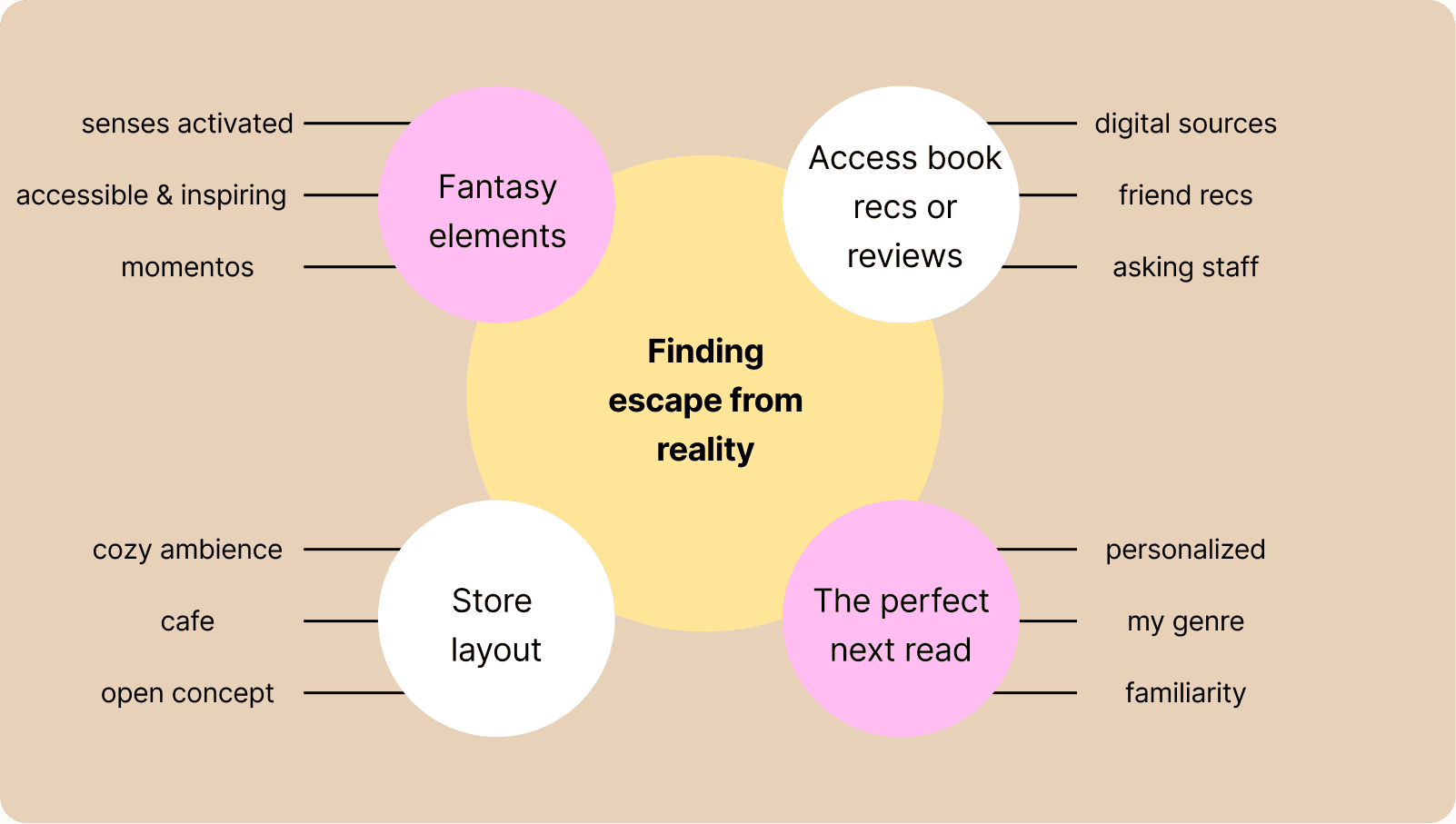
Incorporating feedback from our second round of interviews, we updated our framework to include “fantasy elements” and “find the next perfect read” as important elements that factor into the core “escape from reality.”
03.
Prototype
Prototyping challenge statement
How might we create a magical bookstore experience that allows book lovers to discover their personalized book match?
We built three scale-model prototypes. "Bookmarked" was created in line with our prototype challenge statement, and the "Your Story" and "Books to Die For" concepts were created during a rapid prototyping workshop. The move was from high concept to a scale model prototype. Improved fidelity allowed us to go from shaping the idea to shaping the design. The models were proportional to the dimensions we would have available for the pop-up day, which allowed us to begin building the customer journey.
We presented these models to a panel of experts, and through their critique, we decided that “Bookmarked” was the strongest concept. The critique focused on different aspects of the 5E framework.
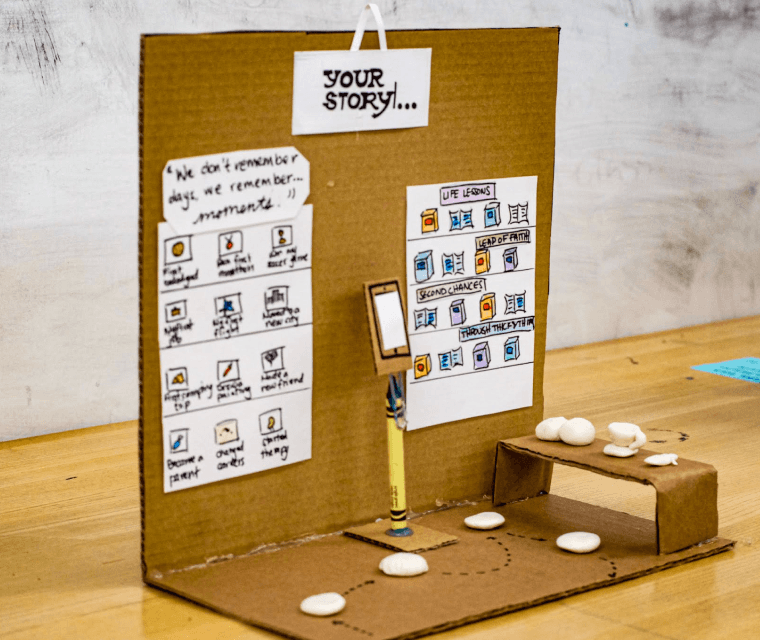
Your story|…
High concept: A bookstore that generates your personalized autobiography inspired by your past, current, or future life events
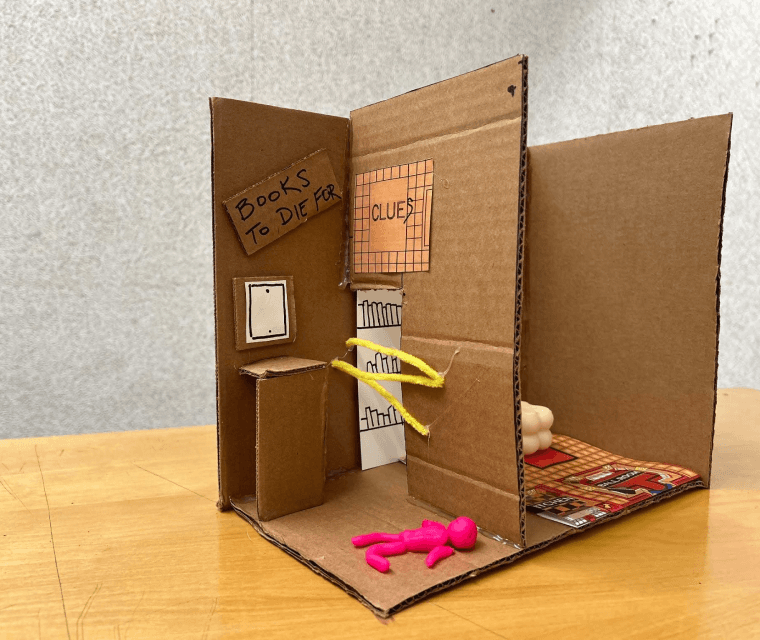
Books to die for:
High concept: Blending the thrill of murder mystery with the discovery of a bookstore
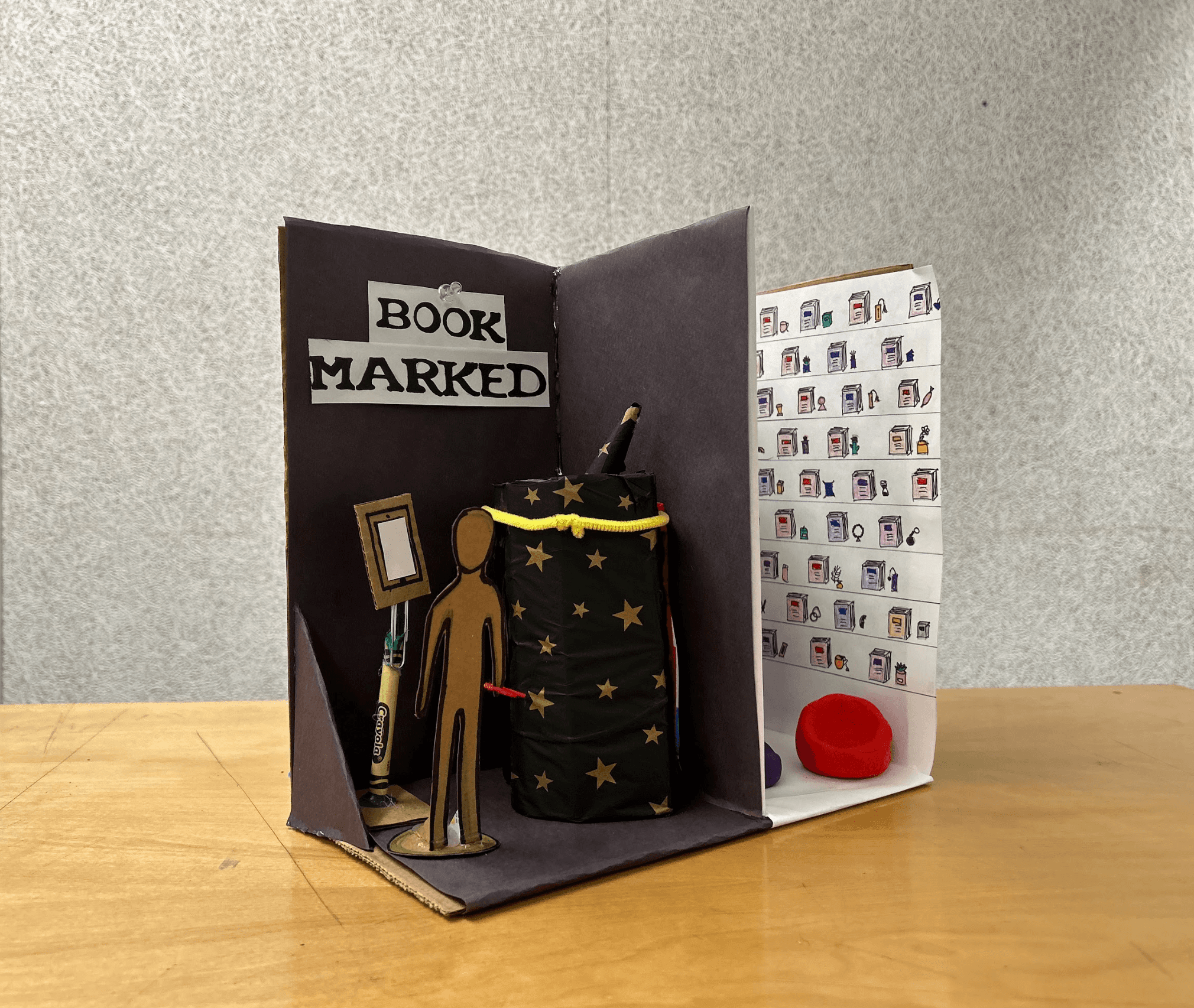
Bookmarked:
High concept: A magical bookstore experience that allows book lovers to discover their personalized book match.
Prototype Critique
09.
Focus on the entrance and magical chamber “You are being transported feeling” via sights, sounds, smells.
10.
Incorporate reader archetypes & emphasize curated experience.
11.
Opportunity for an “I’ve been bookmarked” momento, such as a temporary tattoo, passport stamp, or digital token.
04.
Experiment
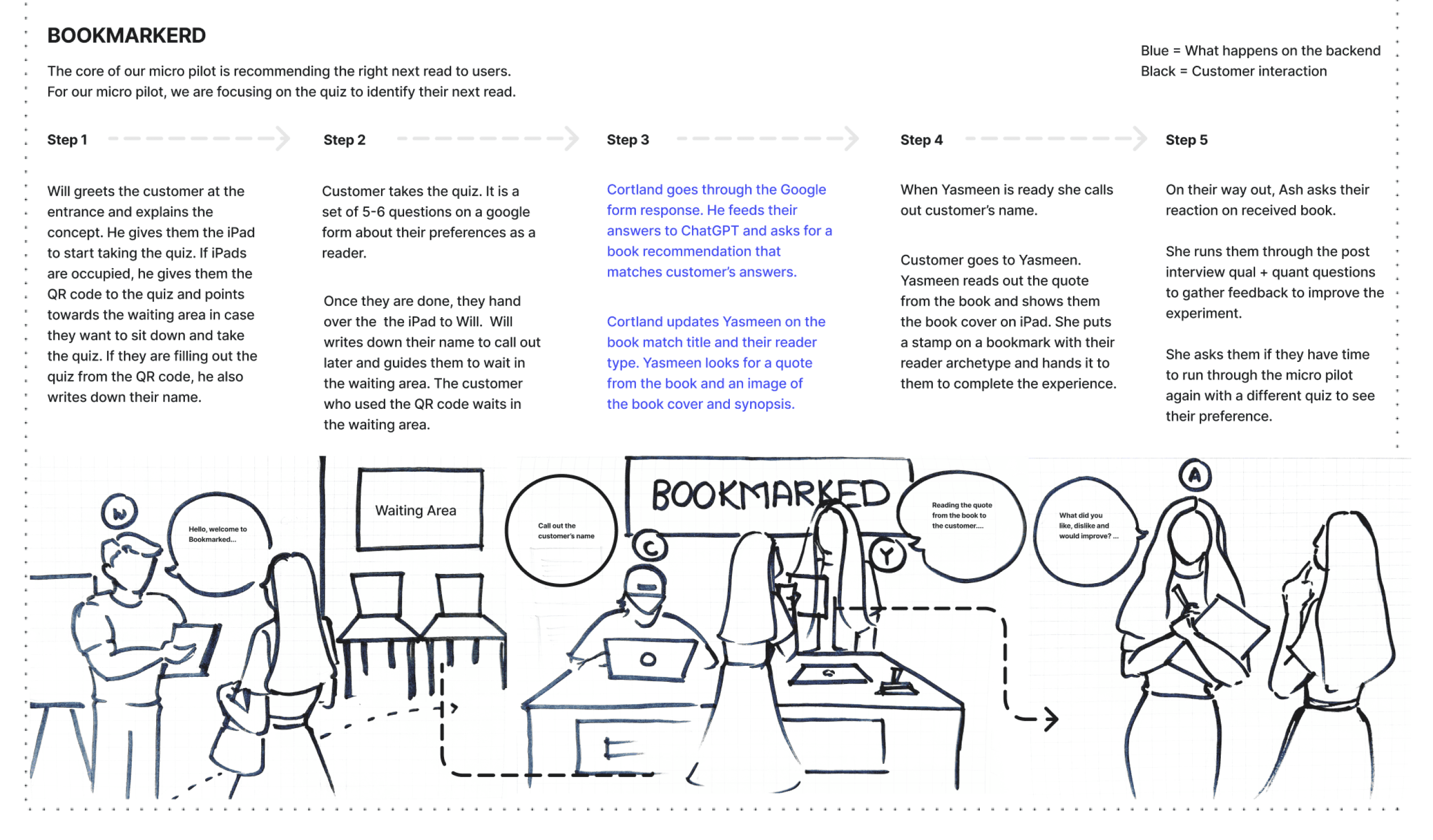
The purpose of the micropilot was to create a lightweight experiment to validate our hypothesis of how we thought customers would act against their true behavior. Our plan tested our biggest uncertainties and we built just enough to get our learnings and move forward.
Uncertainties to test
Will customers feel like their book match resonates with them?
Will the process between quiz completion and the magic chamber take too long?
Hypothesis:
If we have a robust, consistent method of developing a book match based on inputs, the process will be fast & customers will trust their book match.
Customers won’t mind a lack of choice if they have fun and receive a book that interests them
Methods & Measures
Gather data: Have customers test 2 different quizzes to see which resonates. Each is a set of 5-6 questions on a Google Form about their preferences as a reader.
Find and reveal book match: Answers are fed into Chat GPT, giving them their reader archetype as well as a book recommendation.
Collect feedback: This is followed up with an in-person exit interview
Micropilot learnings
12.
Participants preferred a mix of fun and interest-based quiz questions; the full experience averaged 5 minutes.
13.
Users wanted 3–5 book options, especially to avoid repeats of books they’d already read.
14.
The “magic sorting hat” slowed the process; we replaced it with reader types for simplicity.
05.
Deliver
Pop-up day high concept value proposition:
For book lovers looking to discover their next favorite read, Bookmarked is a pop-up bookstore that offers personalized book recommendations through a fun quiz and cutting-edge AI. Unlike other competitors, we blend the warmth of a bookstore and the intelligence of technology to deliver a perfect reading experience you won’t find anywhere else.
Using the 5E Framework to build the user journey:
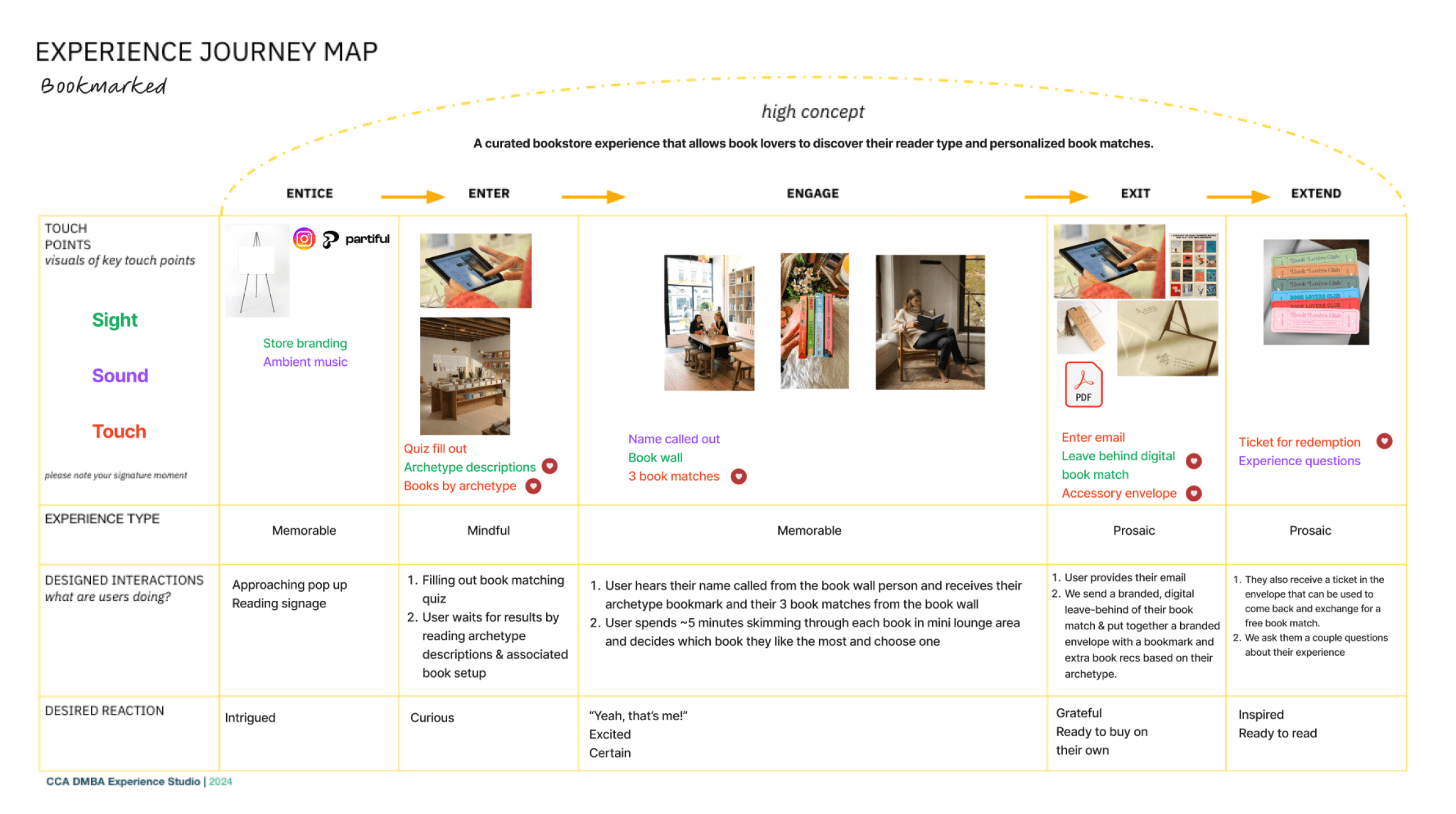
With the 5E framework, we built a journey map so each part of the pop-up coincided with a planned experience. We created branding elements for each section as well as planned the interactions and the desired emotional reaction they would have at each point.
Generating reader architypes:
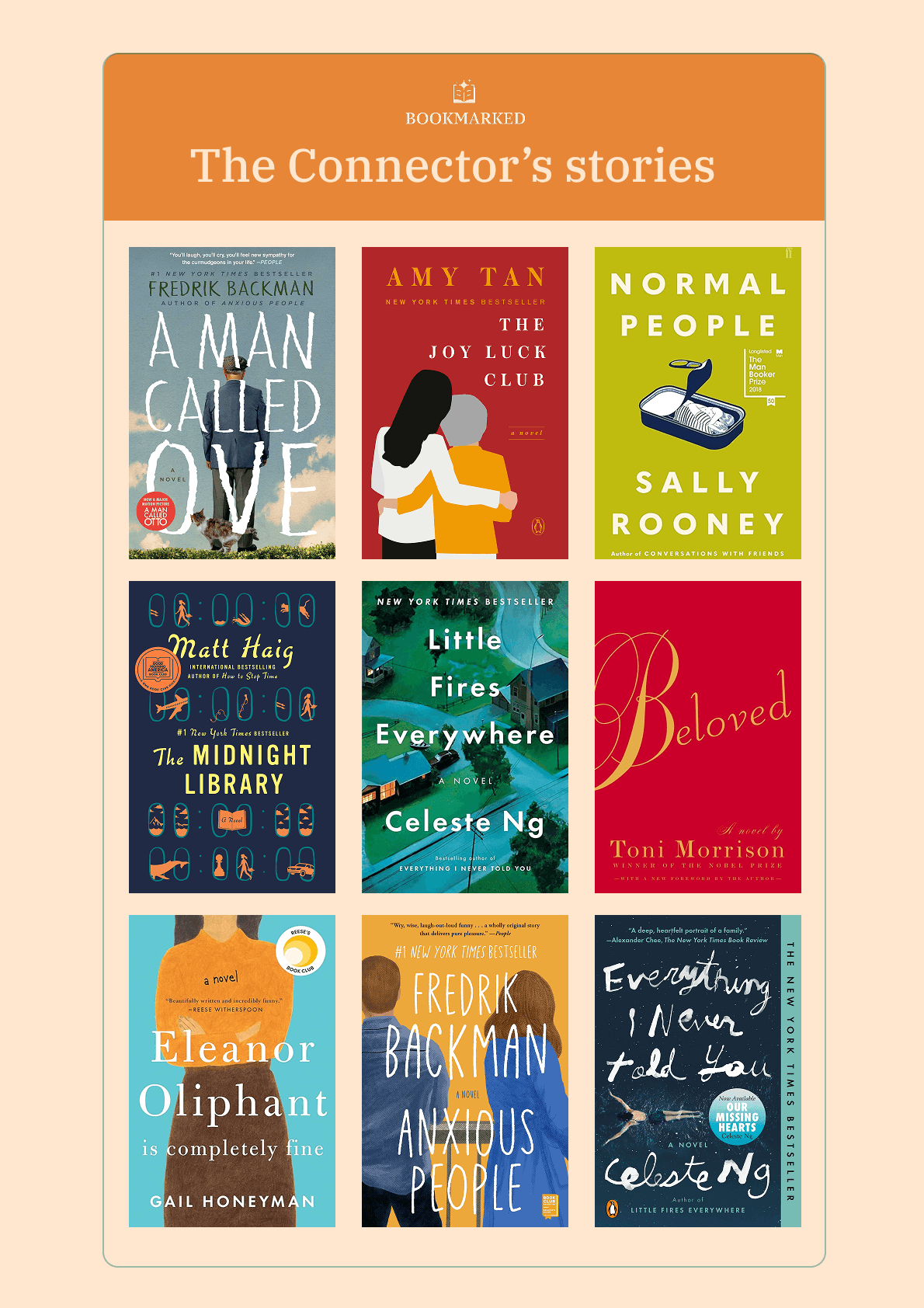
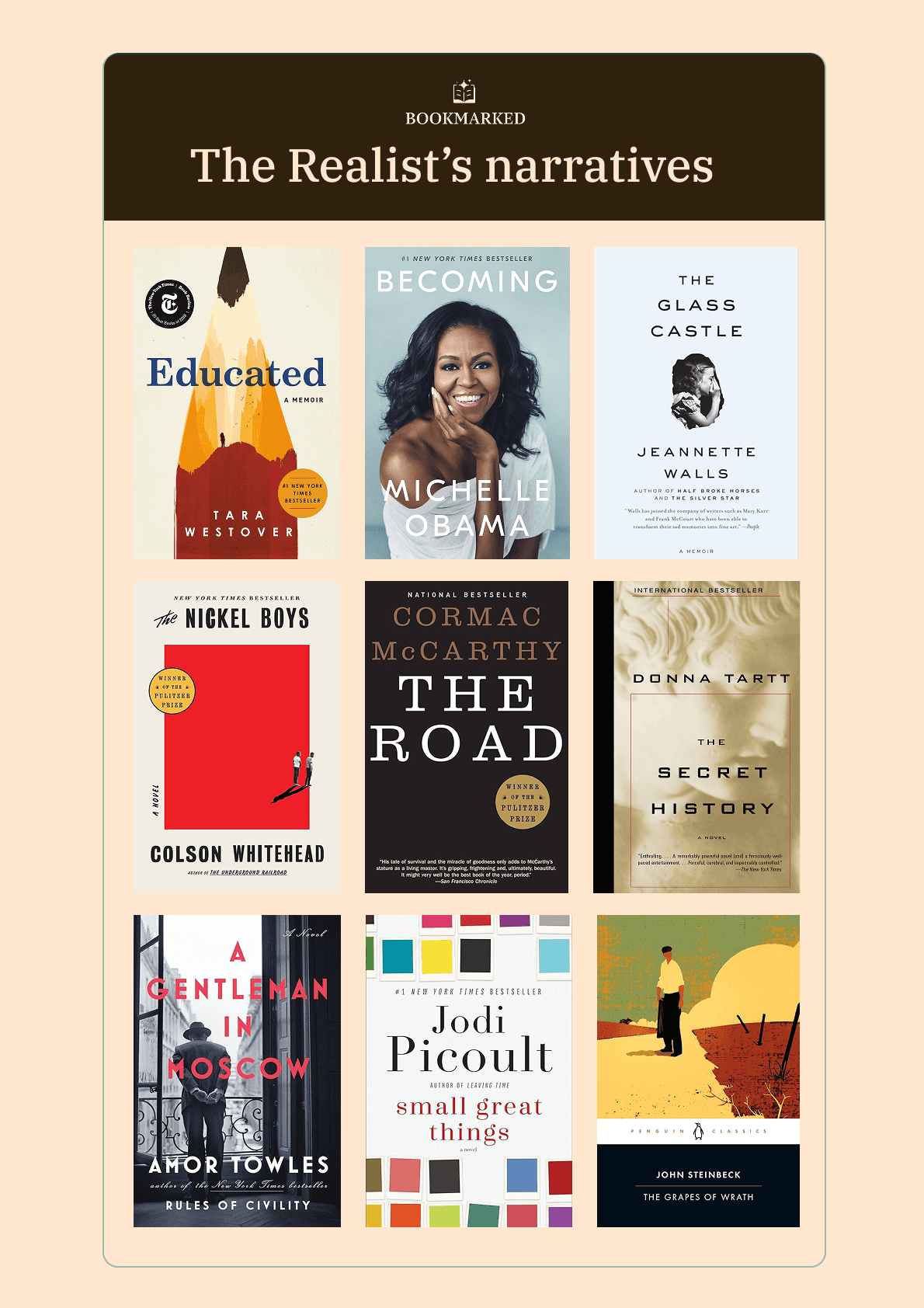
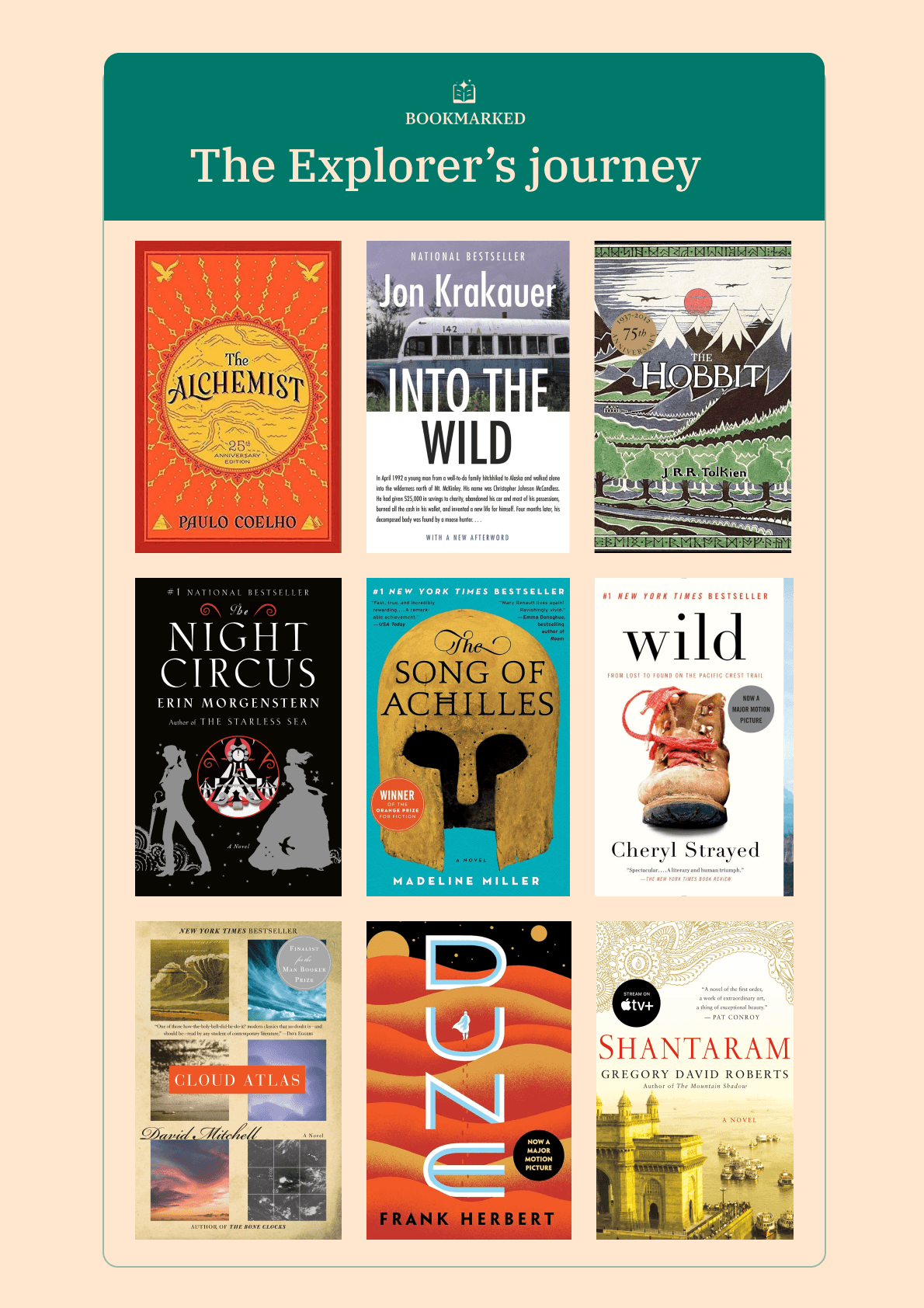
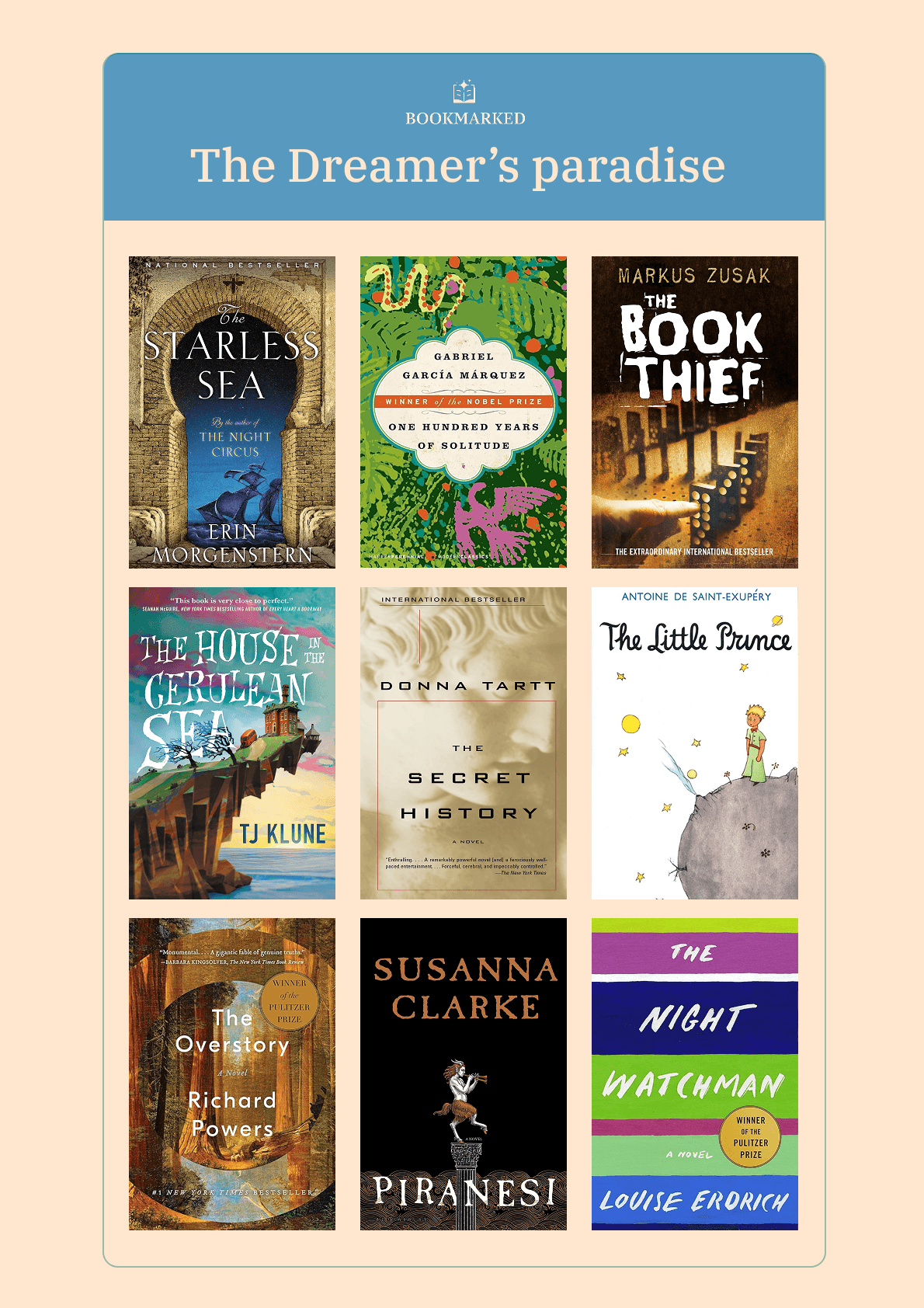
We used a BuzzFeed-style quiz to help visitors discover their “reader archetype.” Behind the scenes, we used ChatGPT to interpret each person’s answers and map them to one of four archetypes, along with a curated set of three books selected from our 100+ title bookwall.
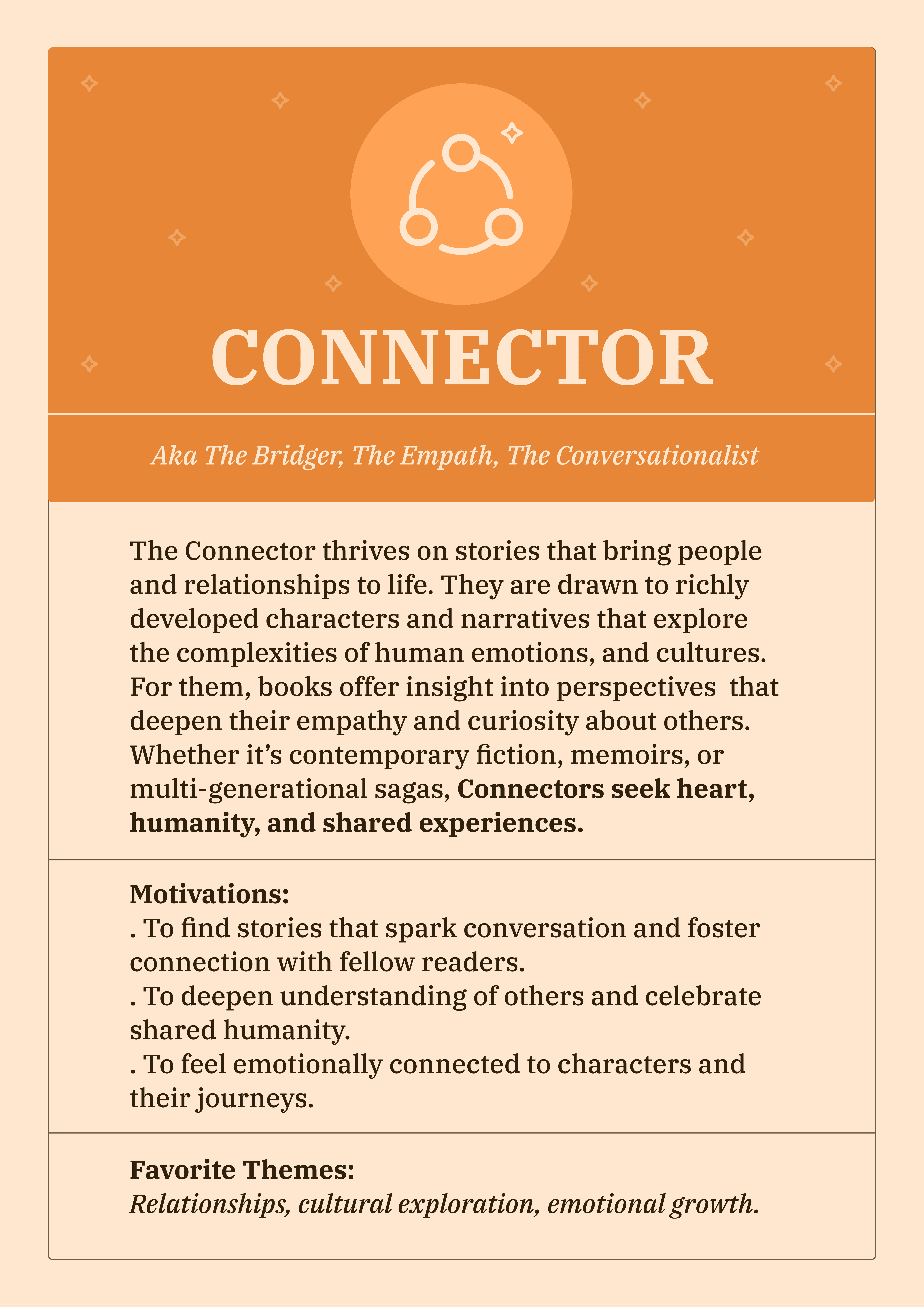
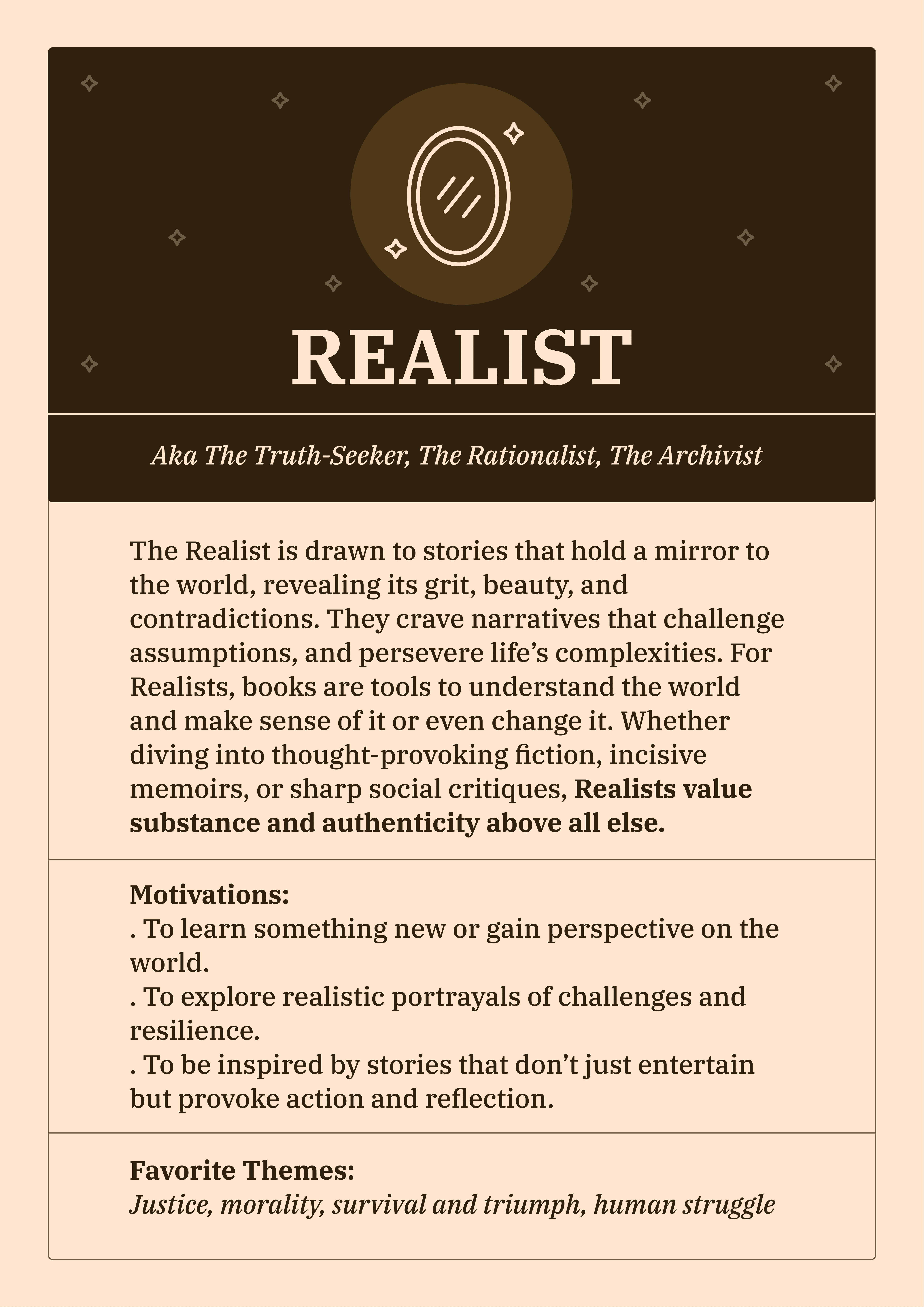
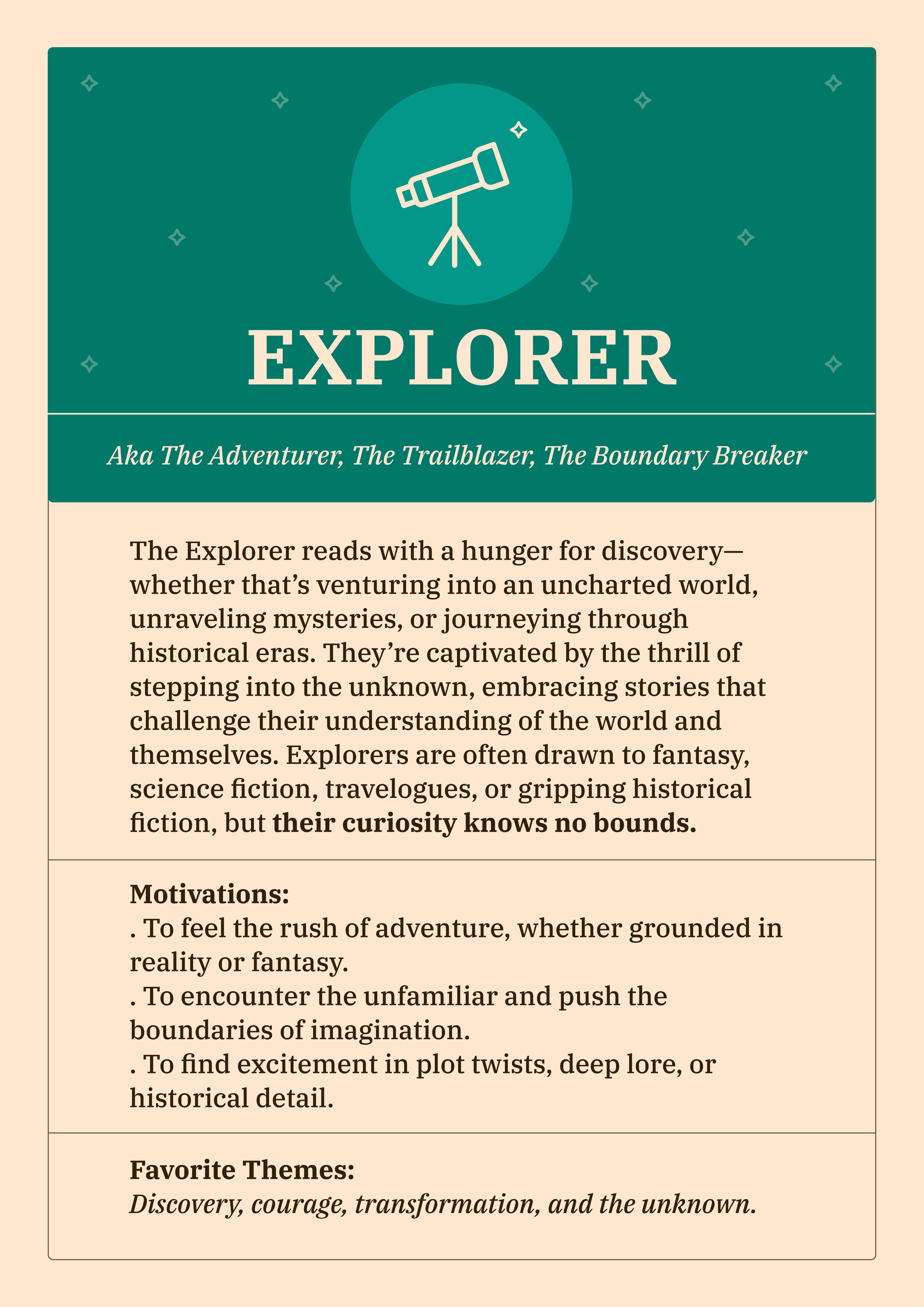
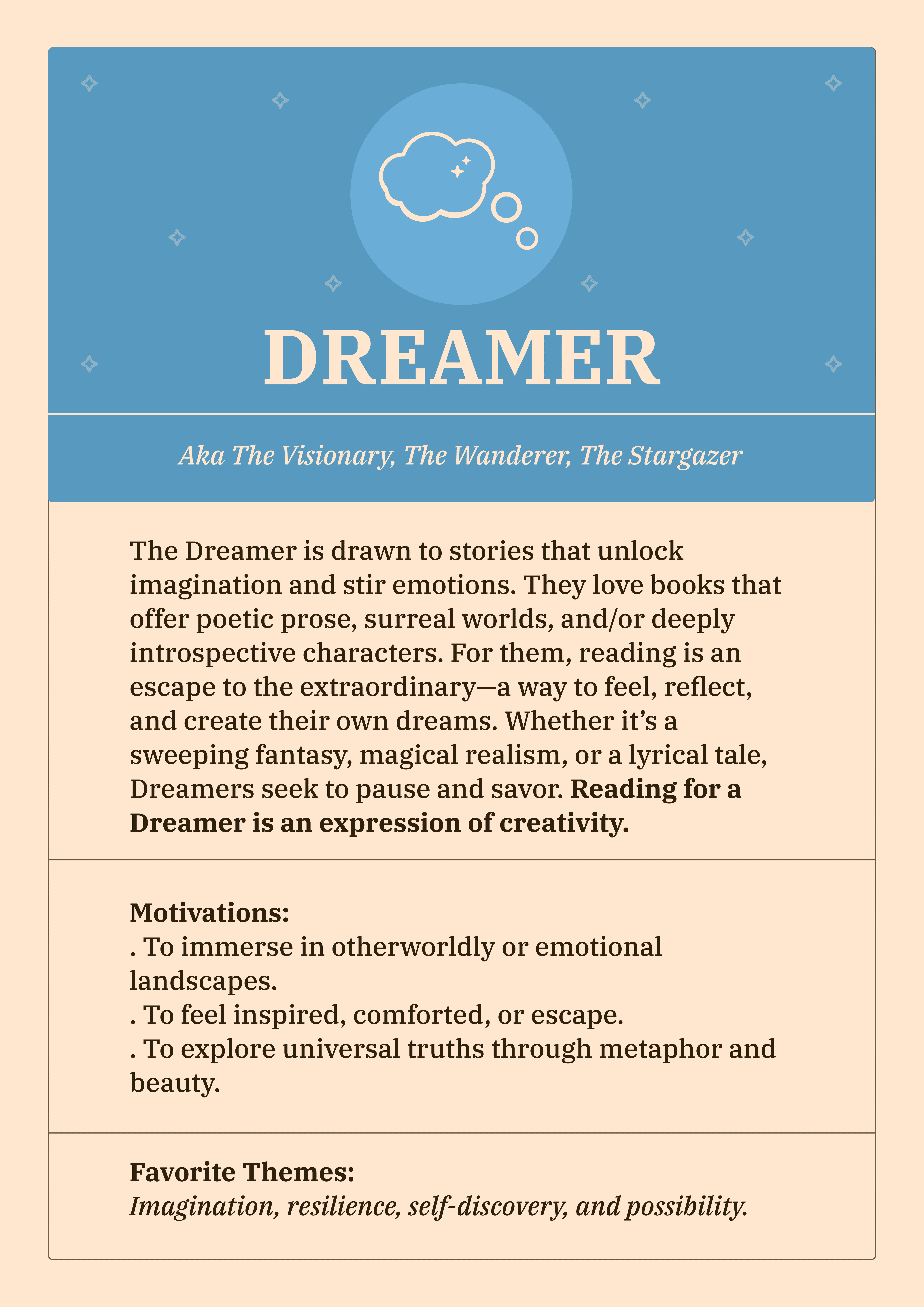
Extending the experience
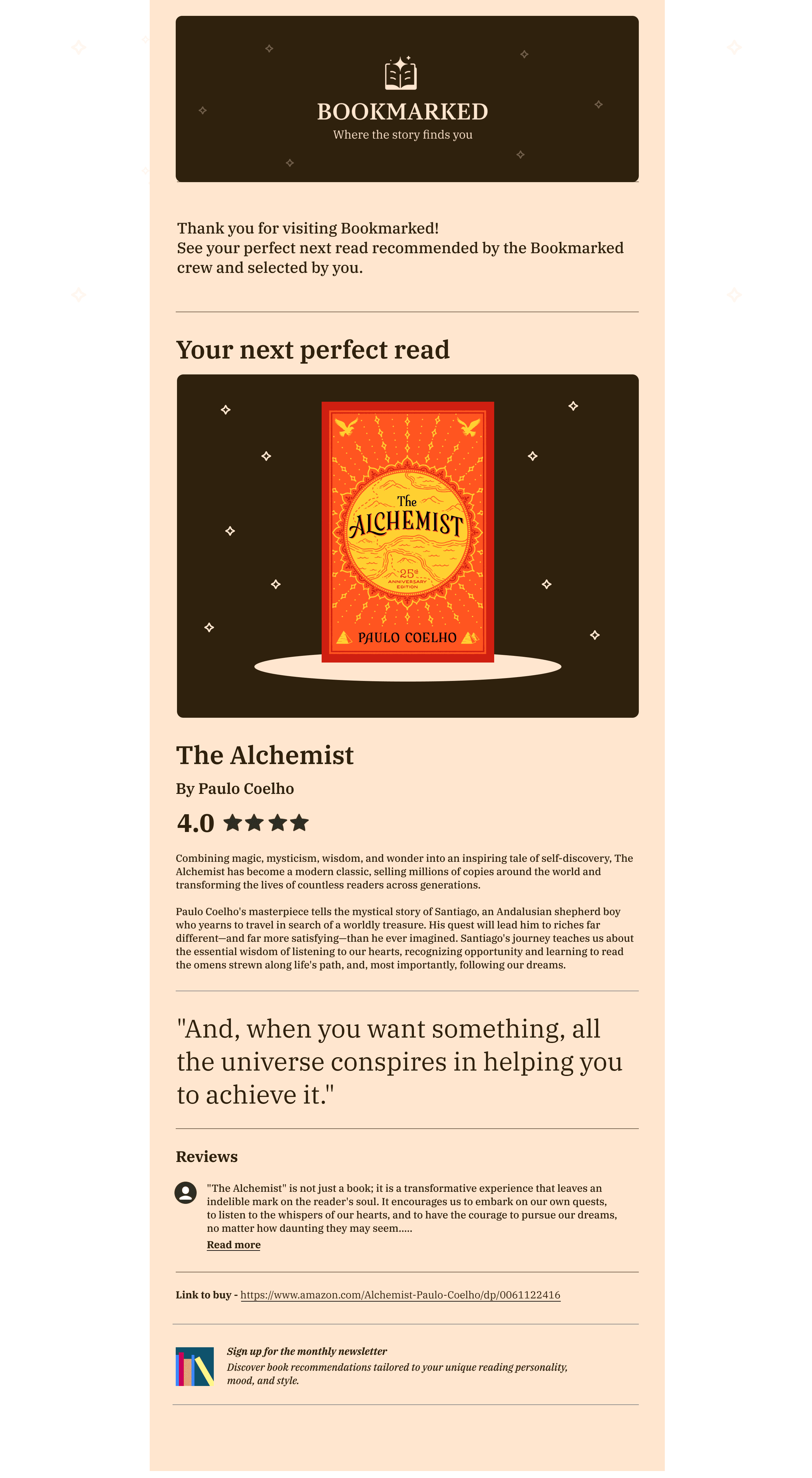
To keep the experience going beyond the pop-up, we sent every visitor a personalized follow-up. Each person received an emailed digital card with their archetype, their book match and where to purchase it, and additional titles they might love. We also gave them a physical bookmark featuring their archetype, along with a coupon inviting them to return. The goal was to extend the moment of discovery into something they could revisit — and act on — long after they left the pop-up.
06.
Project Impact
01.
38 out of 46 visitors said they would come back, recommend the experience, and were satisfied with their book match and personality.
02.
Qualitative feedback:
“I would love this to be a real store! I’d come back because I loved the one-on-one experience, the curation, and the clarity the descriptions gave me. It made the book-choosing process, which is usually overwhelming, feel simple.”
03.
Room to refine: 8 visitors thought they resonated more with another archetype than the one they received; however, they enjoyed the concept and experience.